Secure America Now is a community of over 4 million patriots dedicated to defending American security, values, and freedoms. Through bold advocacy and grassroots action, we hold leaders accountable and fight for a safer, stronger nation.
OUR PRIORITIES
Secure America Now's mission is to bring critical national security threats to the forefront of the American debate.
Learn moreWhatever your vision for America, we all need security and strength to protect it. That’s what Secure America Now fights for. We partner with patriotic Americans like you to defend our nation, safeguard our freedoms, and hold radical liberal politicians accountable—because a strong America is a safe America.
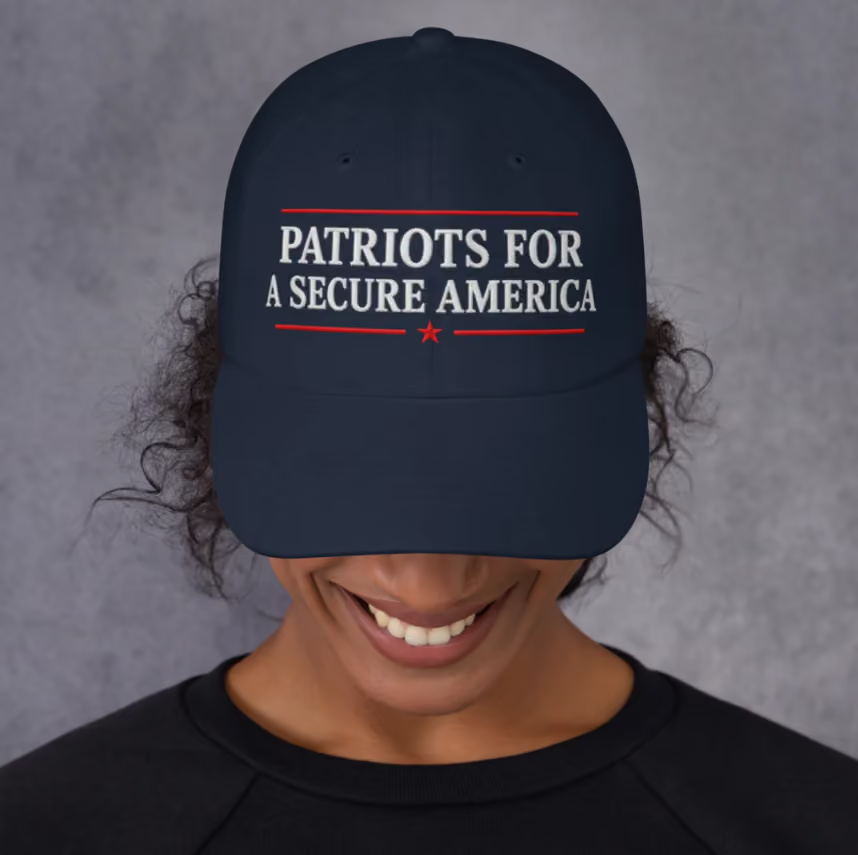
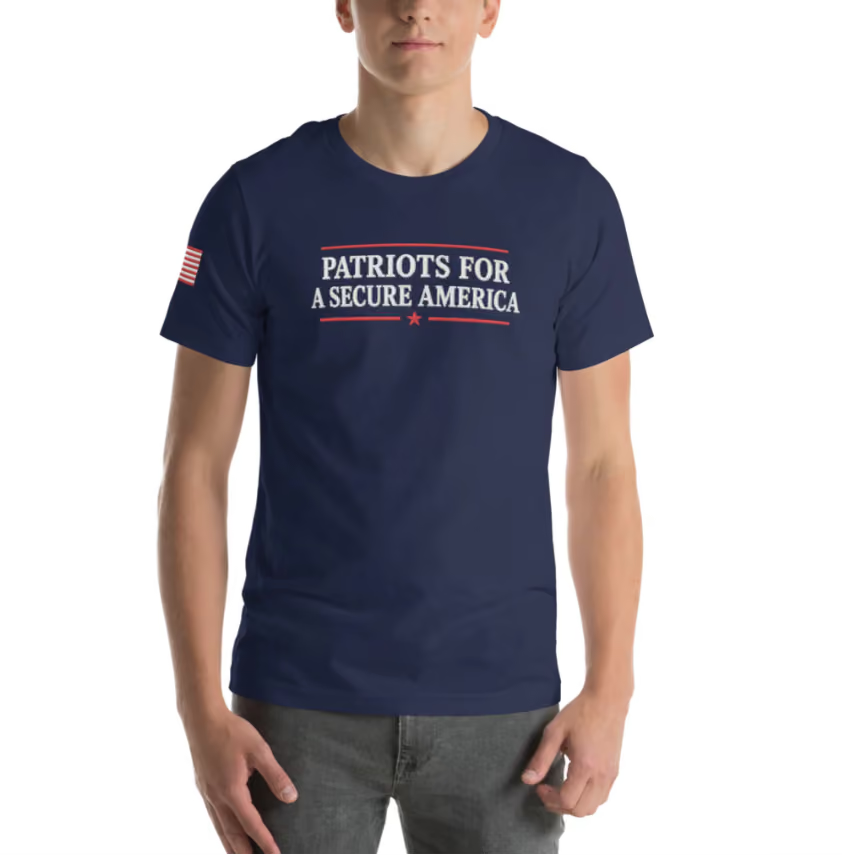
Go to Action Center→Every piece of merch bought from the official SAN store fuels our critical mission to protect our homeland and preserve common-sense national security. When you wear Secure America Now gear, you aren't just making a statement; you are joining a frontline movement of thousands of Americans demanding we maintain borders, put an end to sanctuary cities, and take a clear, unyielding stance against foreign nuclear threats.
SECURE OUR FUTURE TOGETHER- Enter Store Here
Add your name to show that Americans stand firmly with Israel and support decisive action against Iran’s threats. We’re working to ensure this message reaches leaders, communities, and decision-makers nationwide. Your support helps expand that impact.
Stay informed on national security with expert analysis and
hard-hitting discussions on the Code Red Podcast.
On Code Red, Secure America Now’s President, Allen Roth, talks to experts about critical national security threats and their impact on America’s safety.
June 25, 2026

In traditional international diplomacy, sanctions relief operates on a strict "performance-based milestone" system. A hostile state must verifiably dismantle its illicit capabilities before foreign assets are unlocked or restrictions are lifted.
This framework fundamentally reverses that logic by front-loading massive financial concessions to Tehran with zero long-term prerequisites. The timeline of the deal guarantees immediate liquid relief during the initial negotiation phase, long before any verifiable compliance checks occur.
While political talking points assert that any released funds are safely contained within monitored escrow accounts, actions on the ground paint a completely different picture. Yesterday, the Treasury Department systematically removed core sanctions on Iranian oil sales and re-opened the regime's access to the U.S. dollar. The framework of the MOU itself establishes a pipeline for direct, unrestricted capital flow from international energy markets, completely bypassing the escrow structures promised to the public.
The agreement establishes a mechanism for unfreezing assets held in foreign banks. The first wave instantly releases $6 billion to $12 billion in cash, with a legally guaranteed schedule to transfer the remaining $12 billion balance within a tight 60-day window.
Entirely separate from these immediate, highly controversial upfront payouts is a broader, long-term conceptual plan targeting an estimated $300 billion earmarked for economic development and reconstruction financing down the road. However, by treating the immediate multi-billion dollar cash infusions as an upfront baseline, Washington forfeits its primary tool of economic persuasion before long-term metrics are even negotiated.
The structural danger of this arrangement lies in the absolute fungibility of state capital. The Governor of the Central Bank of Iran has already publicly confirmed that these released funds remain sovereign assets of the Central Bank, managed entirely according to domestic regime priorities and foreign-exchange choices. Even if future funds are nominally designated for infrastructure, this immediate cash surge instantly allows the regime to redirect its internal state budget directly into weapons pipelines for its regional proxy networks.
The strategic imbalances of the framework extend far beyond balance sheets, manifesting as heavy-handed operational restrictions on regional security and allied defensive maneuvers.
A critical flashpoint under the current framework is the Strait of Hormuz. Though the maritime corridor remains technically open to international traffic on paper, real-world reporting indicates that Iran has effectively seized operational dominance over the passage. The regime is actively bottlenecking the strait and prioritizing its own commercial tankers to maximize its unrestricted oil profits, holding international shipping lanes hostage while generating a massive economic windfall.
While Tehran enjoys unencumbered maritime maneuvering and immediate liquidity, the framework places severe strategic restrictions on Israel. A key criticism of the framework is that a bilateral understanding between Washington and Tehran is being used to dictate terms to a non-party, crippling its ability to combat regional threats.
According to policy analysis, the text commits the signing parties "and their allies" to an immediate and permanent halt to military operations across all active fronts, explicitly detailing operational restrictions within Lebanon:
The danger of the 2026 framework can be summarized simply: it swaps permanent economic leverage for a temporary, fragile pause in fighting.
The arrangement locks in an immediate financial windfall for a hostile state sponsor of terror while shifting an immense strategic burden onto our closest democratic ally. It prioritizes the short-term optics of a ceasefire over the long-term operational necessity of fully dismantling proxy threats. Without durable security mandates, including an unyielding permanent nuclear zero, zero preemptive cash payouts, and total freedom of movement for international waterways like the Strait of Hormuz, the current framework delivers only a superficial, entirely reversible calm while leaving our allies exposed.
June 15, 2026

Secure America Now Via X
A newly released report in the United Kingdom is forcing a painful national conversation.
For many Americans, the story may sound unbelievable.
For decades, vulnerable girls across Britain were groomed, trafficked, sexually exploited, and abused by organized grooming gangs. According to the inquiry and numerous criminal investigations, many of these gangs were made up of men from Pakistani Muslim backgrounds operating within closed communities. Victims, parents, whistleblowers, journalists, and lawmakers repeatedly sounded the alarm. Yet according to the report, many institutions failed to intervene effectively, allowing the abuse to continue for years. The result is one of the most controversial and emotionally charged scandals in modern British history.
While Americans may be unfamiliar with the names Rotherham, Rochdale, Telford, or Oxford, those communities have become synonymous with a broader debate about public safety, immigration, cultural integration, political correctness, and institutional accountability.
The newly released Rape Gang Inquiry report attempts to bring together survivor testimony, whistleblower accounts, court records, previous investigations, and expert analysis into one comprehensive examination of what happened.
The findings are disturbing.
According to the report, organized grooming gangs operated across large portions of the United Kingdom for decades.
The report cites evidence from at least 149 local authority districts and argues that the abuse was not confined to one town, one region, or one isolated criminal organization.
Instead, investigators describe a recurring pattern that appeared in community after community.
Young girls, some as young as 11 years old, were allegedly targeted because they were vulnerable.
Many came from troubled homes.
Many were in foster care.
Many struggled with mental health challenges or family instability.
According to survivor testimony, the grooming process often followed a similar pattern.
Victims were approached by older men.
They were offered attention, gifts, alcohol, cigarettes, or drugs.
Trust was established.
Control followed.
The abuse escalated.
Many survivors described being trafficked between locations, sexually assaulted by multiple perpetrators, threatened into silence, and subjected to years of trauma.
Some became pregnant.
Some suffered severe physical injuries.
Many continue to deal with psychological trauma decades later.
The report describes these crimes as systematic rather than isolated.
The inquiry also highlights a recurring and highly controversial pattern: many of the organized grooming gangs examined in previous investigations involved perpetrators from Pakistani Muslim backgrounds. The report argues that this pattern was too often avoided or downplayed by officials who feared accusations of racism, discrimination, or community backlash. The result, according to the inquiry, was that vulnerable girls were left exposed while organized abuse networks continued to operate.
Perhaps the most shocking claim in the report involves the potential scale.
Drawing on previous British investigations and parliamentary discussions, the report cites estimates suggesting that as many as 250,000 girls may have been victimized over multiple decades.
That figure remains heavily debated.
However, even critics of the estimate generally agree that the number of victims was substantial and that the problem was significantly larger than initially acknowledged by authorities.
The report repeatedly argues that official statistics likely understate the true scale because many cases were never reported, never investigated, or never recorded properly.
One uncomfortable reality emerges throughout the report:
No one truly knows how many victims there were.
And that uncertainty exists because institutions failed to collect consistent data for years.
The most important question is not whether crimes occurred.
That has already been established through criminal convictions, local investigations, government reviews, and survivor testimony.
The central question is:
How did it continue for so long?
The report argues that multiple institutions failed simultaneously.
Police. Social services. Schools. Healthcare providers. Local governments. Political leaders.
According to the report, warning signs existed for years.
Victims reported abuse. Parents reported abuse. Teachers raised concerns. Medical professionals documented injuries. Whistleblowers attempted to intervene.
Yet meaningful action often came late, or not at all.
Some survivors testified that authorities treated them as troublemakers rather than victims.
Others said they felt completely abandoned by the very systems designed to protect them.
This is where the issue becomes particularly controversial.
The report argues that many officials became reluctant to confront the role of radical Islamist grooming gangs because they feared accusations of racism, discrimination, or damaging community relations. According to the inquiry, that reluctance contributed to years of institutional inaction while organized abuse continued.
Critics caution against broad conclusions about entire communities or faiths based on the actions of criminal offenders. However, the report maintains that public officials cannot allow political sensitivities to prevent them from confronting criminal networks or extremist influences when vulnerable children are at risk.
Supporters of this view argue that authorities became reluctant to ask difficult questions because they feared political backlash.
Critics argue the issue is more complex and caution against broad conclusions about entire communities based on the actions of criminal offenders.
Regardless of where one falls in that debate, the report reaches a clear conclusion:
Political concerns should never outweigh public safety concerns.
The report argues that protecting vulnerable children should always come before protecting political narratives.
That lesson extends far beyond Britain.
America is not Britain.
The demographics are different.
The immigration system is different.
The legal system is different.
The cultural landscape is different.
But the underlying lesson transcends national boundaries.
The report is ultimately a case study in institutional failure.
It demonstrates what can happen when warning signs are ignored.
It demonstrates what can happen when political sensitivities discourage honest conversations about radical Islamist extremism, organized criminal networks, and other public safety threats.
Those lessons apply everywhere. Including the United States.
Americans are currently engaged in heated debates over border security, immigration enforcement, community integration, radical Islamist extremism, domestic security, law enforcement priorities, and public safety.
Reasonable people can disagree about policy solutions.
What should not be controversial is the principle that governments must be willing to identify threats, investigate them honestly, and act before vulnerable people become victims.
That principle applies regardless of ideology.
The grooming gang scandal is not simply a British story.
It is a warning about what happens when institutions stop doing their jobs.
It is a warning about the dangers of bureaucratic paralysis.
It is a warning about what happens when leaders become more concerned with avoiding controversy than confronting reality.
Most importantly, it is a reminder that public trust depends on accountability.
Citizens expect governments to protect the vulnerable.
Parents expect authorities to act when children are in danger.
And when institutions fail, the consequences can last for generations.
The victims deserve answers.
The public deserves transparency.
And policymakers deserve a full understanding of what went wrong.
At Secure America Now, we believe Americans should study this tragedy carefully, not because Britain and America are identical, but because history repeatedly demonstrates the cost of ignoring warning signs.
The goal is not to stigmatize entire communities or faiths.
The goal is to ensure governments never again allow fears of political controversy to prevent them from confronting radical Islamist extremism, organized criminal networks, or any threat that places vulnerable children at risk.
The goal should be vigilance. The goal should be accountability. And the goal should be ensuring that no community, anywhere in the Western world, repeats these failures.
Britain is still reckoning with the consequences.
America should be paying attention.
June 15, 2026

Secure America Now via X
For years, the Council on American-Islamic Relations (CAIR) has branded itself as a “civil rights” group. The media repeats the label. Politicians attend their events. But behind the polished press releases lies a darker truth: CAIR is not a civil rights organization. It is a front for the Muslim Brotherhood tied to Hamas, steeped in terror, and working to undermine America from within.
CAIR was founded in 1994 by operatives connected to the Muslim Brotherhood. The same Brotherhood that birthed Hamas, Al-Qaeda sympathizers, and jihadist movements worldwide.
In 2008, federal prosecutors tied CAIR directly to Hamas’ U.S. support network during the Holy Land Foundation terror-funding trial, the largest terror finance case in American history. CAIR was named an unindicted co-conspirator.
The FBI uncovered a Brotherhood “Explanatory Memorandum” that laid out the mission for America: 👉 “Civilizational jihad from within.”
CAIR was part of that plan. Not to defend civil rights, but to create a shield for Islamist agendas.📄 Source: The Muslim Brotherhood’s Strategic Plan for America
Tied to Hamas: Exposed in federal court as part of the Hamas funding web.
Leaders support terror: CAIR co-founder Nihad Awad publicly said, “I am in support of Hamas.”
Anti-law enforcement: CAIR routinely smears the FBI and fights terror watch lists.
Global agenda: CAIR isn’t a charity. It’s a shield for a global Islamist caliphate.
Every time terrorists strike, CAIR points fingers at America, never at Hamas.
President Trump is moving to designate the Muslim Brotherhood and its U.S. branches, like CAIR, as Foreign Terrorist Organizations (FTOs).
This would cut off their influence, funding, and legitimacy in America once and for all. Patriots, we must rally behind this move.
👉 Take Action: Demand Congress designate the Muslim Brotherhood & CAIR as FTOs.
Q: Isn’t CAIR a civil rights group?
A: That’s the cover story. In reality, CAIR was built out of Hamas’ U.S. support network and has been linked to terror financing.
Q: Why did the FBI cut ties with CAIR?
A: In 2008, the FBI formally severed relations after uncovering CAIR’s Hamas connections during the Holy Land Foundation trial.
Q: What did CAIR’s leaders say about Hamas?
A: CAIR’s co-founder, Nihad Awad, once declared: “I am in support of Hamas.” That’s not civil rights — that’s open allegiance to terror.
Q: How is CAIR tied to the Muslim Brotherhood?
A: The Brotherhood’s own “Explanatory Memorandum” named CAIR as part of its plan for “civilizational jihad” in America.
Q: Why does this matter now?
A: Because President Trump is moving to designate the Brotherhood and its affiliates as terrorist organizations. That means CAIR’s days of hiding behind “civil rights” branding could be numbered, but only if patriots demand action.
CAIR = Muslim Brotherhood.CAIR = Hamas.CAIR = Terror’s Trojan Horse in America.
👉 Don’t be fooled. Don’t stay silent.
Take action today to designate CAIR & the Muslim Brotherhood as terrorist organizations.
Uncovering the Truth on Top
National Security Issues