Secure America Now is a community of over 4 million patriots dedicated to defending American security, values, and freedoms. Through bold advocacy and grassroots action, we hold leaders accountable and fight for a safer, stronger nation.
OUR PRIORITIES
Secure America Now's mission is to bring critical national security threats to the forefront of the American debate.
Learn moreWhatever your vision for America, we all need security and strength to protect it. That’s what Secure America Now fights for. We partner with patriotic Americans like you to defend our nation, safeguard our freedoms, and hold radical liberal politicians accountable—because a strong America is a safe America.
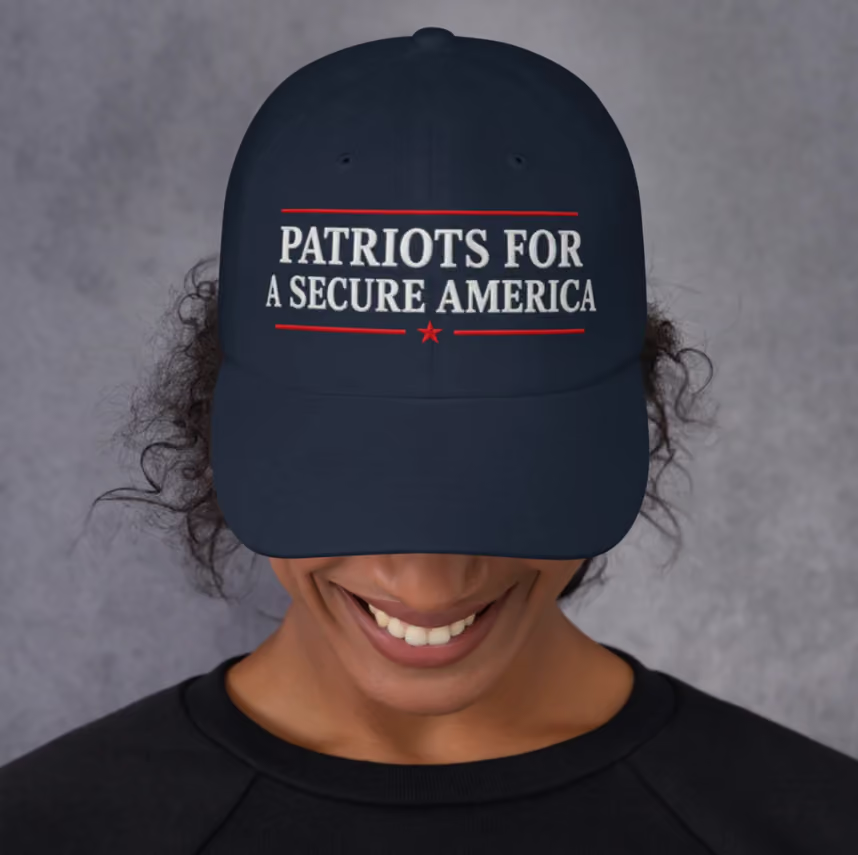
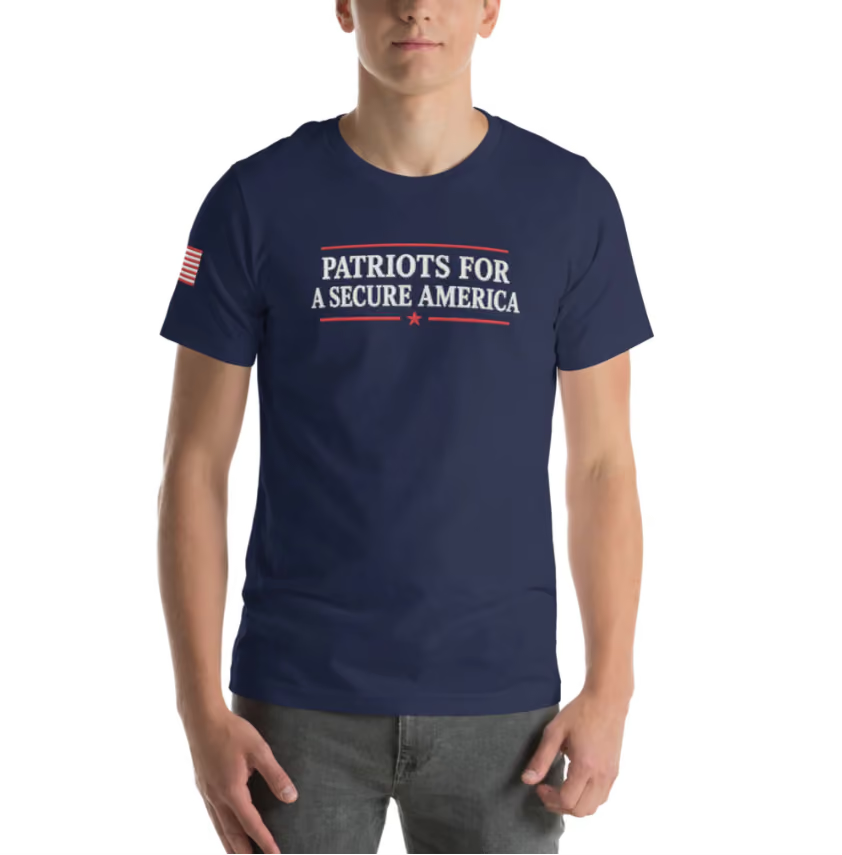
Go to Action Center→Every piece of merch bought from the official SAN store fuels our critical mission to protect our homeland and preserve common-sense national security. When you wear Secure America Now gear, you aren't just making a statement; you are joining a frontline movement of thousands of Americans demanding we maintain borders, put an end to sanctuary cities, and take a clear, unyielding stance against foreign nuclear threats.
SECURE OUR FUTURE TOGETHER- Enter Store Here
Add your name to show that Americans stand firmly with Israel and support decisive action against Iran’s threats. We’re working to ensure this message reaches leaders, communities, and decision-makers nationwide. Your support helps expand that impact.
Stay informed on national security with expert analysis and
hard-hitting discussions on the Code Red Podcast.
On Code Red, Secure America Now’s President, Allen Roth, talks to experts about critical national security threats and their impact on America’s safety.
September 7, 2026

Labor Day honors the hardworking Americans whose sacrifice and determination keep our country running.
From construction sites and factories to farms, hospitals, police departments, and military installations, American workers build our communities, protect our families, and strengthen our nation every day.
They deserve a government that works just as hard to protect them.
National security directly affects the Americans who work, raise families, and build communities across the country.
Working Americans depend on secure borders, enforced laws, safe neighborhoods, strong institutions, and a dependable national defense. This Labor Day, Secure America Now is calling for policies that protect the people who keep our country strong.
SIGN THE PETITION AND STAND WITH AMERICAN WORKERS
Border security is a national security and public safety responsibility.
The federal government must secure the border, enforce immigration laws, and properly screen those entering the United States. Local and federal authorities should also work together to keep dangerous individuals out of American communities.
American workers should not have to bear the consequences of illegal immigration and sanctuary policies. They deserve secure borders, lawful immigration, and leaders committed to public safety.
Law enforcement officers, firefighters, first responders, and service members work every day to protect the American people. Many of them spend Labor Day on duty while others spend time with their families.
Their service and sacrifice must never be taken for granted.
Supporting law enforcement means giving officers and agencies the resources, cooperation, and policies they need to protect our communities.
Protecting American families also requires confronting radical Islamist extremism and preventing extremist networks from influencing the institutions that shape our laws, communities, and national security.
This effort must remain focused on extremists and organizations that promote violence, support terrorism, or threaten the United States.
America must also hold Iran’s regime accountable and prevent it from threatening Americans and our allies. Peace through strength requires clear priorities, credible deterrence, and leaders who put American security first.
American workers deserve:
SIGN THE PETITION AND STAND WITH AMERICAN WORKERS
American workers built this country through sacrifice, determination, and hard work. They deserve more than words of appreciation. They deserve leaders who will defend them.
This Labor Day, Secure America Now stands for secure borders, safe communities, strong law enforcement, and peace through strength.
Stand with Secure America Now and help us keep America safe.
September 4, 2026

Conservative political creators are no longer operating at the edge of the news business. They are becoming one of its main entry points.
Instead of waiting for a television segment, newspaper column, or network correspondent, millions of Americans now encounter political news through street interviews, podcast exchanges, reaction videos, confrontations, and short clips selected by an algorithm. The creator is often the reporter, host, editor, analyst, and distributor at the same time.
For Secure America Now, this shift has major strategic consequences. Stories involving illegal immigration, violent crime, Iran, radical Islam, Israel, and threats to American institutions are increasingly being introduced to younger audiences by conservative personalities. These creators are reaching Americans with stories and arguments that establishment gatekeepers often downplay, sanitize, frame differently, or never put in front of younger audiences.
The numbers demonstrate how significant the shift has become. Pew Research Center reported in December 2025 that 38% of Americans under 30 regularly get news from news influencers. The Reuters Institute reported in 2026 that young people using social and video platforms pay more attention to individual news creators than traditional news brands, 51% compared with 39%.
The reason is straightforward: creators deliver information in the formats younger Americans already watch.
Conservative creators bypass traditional news by publishing directly to audiences on YouTube, X, Instagram, TikTok, Rumble, and other digital platforms.
Their advantage comes from speed, recognizable personalities, direct audience relationships, and platform-native formats that combine information with entertainment. Some conduct original reporting. Others provide analysis, argument, satire, or cultural commentary.
The most effective creators understand that audiences are not simply looking for facts. They are looking for someone who can show them why those facts matter.
Here are five ways the new political media is changing how Americans encounter national-security and cultural issues.
Traditional reporting usually places a correspondent between the audience and the event. Street creators remove much of that distance.
Nick Shirley has built a recognizable style around arriving at politically charged locations, approaching people directly, and asking questions on camera. In the clip featured in this package, Shirley visits a Texas mosque while investigating questions surrounding EPIC City. After he says he is not Muslim, he is told that he cannot remain in part of the mosque.
Whether viewers agree with Shirley’s conclusions or not, the format is powerful because the audience watches the encounter unfold. There is no studio desk and little institutional mediation. The tension comes from uncertainty. The creator does not know exactly what the next person will say or how the interaction will end.
That makes street reporting especially effective for issues involving immigration, protests, campus politics, public safety, religious influence, and threats to American institutions. Questions that might otherwise remain abstract become visible and immediate.
Why it works: Shirley places viewers inside an encounter that traditional media might reduce to a headline, brief quotation, or carefully edited segment.
Government data rarely arrives in a compelling form. Agency reports, tables, and enforcement statistics may contain important information, but they are not naturally designed for social feeds.
Steven Crowder turns those materials into direct visual arguments. In the immigration clip included in this package, Crowder uses headlines, enforcement statistics, and side-by-side comparisons to challenge the claim that there is no meaningful difference between the Trump and Biden administrations.
The format does more than cite numbers. It gives those numbers a narrative. One approach emphasizes border enforcement, while the other is presented as weakening America’s ability to control illegal immigration.
For national-security organizations, the lesson is important. Statistics about border encounters, removals, visa enforcement, terrorism, sanctions, and criminal arrests become more memorable when they are organized around a clear and consequential choice.
Why it works: Crowder transforms scattered policy information into a contrast that viewers can understand and share within seconds.
Creators do not only react to stories after they become national news. They can also direct public attention toward cases that institutions and major news organizations have failed to pursue with sufficient urgency.
In the clip featured here, Matt Walsh recounts his coverage of Ronald Exantus, a violent offender who was released on parole and found living next to an elementary school in Florida. Walsh says his reporting brought additional attention to the case and prompted closer scrutiny from state officials.
Florida authorities subsequently placed Exantus under surveillance and arrested him for failing to register as a convicted felon.
The clip works because it gives audiences more than commentary. It shows how a creator can elevate a local public-safety failure, generate national attention, and pressure authorities to act.
For SAN, this is the kind of creator content that connects directly to law and order. It exposes what can happen when dangerous offenders are returned to American communities without sufficient accountability or oversight.
Why it works: Walsh turns an overlooked case into a clear argument about violent crime, government responsibility, and the protection of American children.
Podcasting has created another route around the traditional newsroom. Instead of compressing an argument into a short television segment, hosts can explore it through a longer conversation and distribute the strongest moments as individual clips.
Patrick Bet-David’s discussion of the Islamic call to prayer in Times Square demonstrates that approach. He asks whether countries such as Iran or Yemen would permit thousands of Christians to worship with the same visibility and freedom.
The question transforms a complicated discussion about religious liberty, reciprocity, cultural confidence, and hostile regimes into a challenge viewers can immediately understand and debate.
For SAN, the issue extends beyond one public religious display. America’s commitment to religious liberty should not prevent its leaders from confronting radicalization, foreign ideological influence, the persecution of Christians, or movements that reject the freedoms protecting them.
A long podcast can provide context, while a short clip can introduce the argument to millions of viewers who may never watch the entire episode.
Why it works: Bet-David uses a pointed question to connect an American cultural moment with a larger debate about freedom, reciprocity, and national security.
Political communication is not limited to legislation and official statements. Images, gestures, clothing, and public appearances can carry political meaning of their own.
Ben Shapiro’s commentary on New York Governor Kathy Hochul wearing a headscarf at an Islamic center focuses on that symbolic dimension. Shapiro contrasts Hochul’s appearance with the reality that women living under some Islamist regimes face legal or social coercion over how they dress.
The argument is not simply about a garment. It is about what American leaders choose to celebrate and what they choose to ignore.
When political officials embrace religious symbolism for a public appearance while saying little about women resisting coercion under Islamist regimes, creators can expose the contradiction in a way that conventional coverage may avoid.
For SAN, the stakes are larger than one appearance. American leaders must be willing to distinguish religious freedom from political accommodation and confront radical Islamist influence without sanitizing its treatment of women, its hostility toward Western values, or its threats to American institutions.
The August 2026 appearance generated national attention partly because conservative commentators challenged the political symbolism behind the event rather than treating it as an ordinary ceremonial visit.
Why it works: Shapiro connects a single image to a larger argument about political accommodation, women’s freedom, Islamist coercion, and cultural double standards.
The success of these creators is not simply the result of ideology. Their formats match how younger audiences use digital platforms.
Traditional outlets ask audiences to trust an institution. Creator media asks audiences to trust, or at least recognize, an individual.
A recurring voice, face, style, sense of humor, and worldview creates familiarity across hundreds of videos. Viewers begin to understand how a creator approaches an issue before the clip even begins.
A viewer does not need to begin by searching for a policy report or government document. A compelling scene, question, contradiction, or confrontation can introduce the issue first.
Once attention has been earned, facts and context can follow.
Younger users frequently encounter political news without deliberately searching for it. Pew’s 2025 research found that among adults under 50 who regularly get news from influencers, 72% said they mostly happen to come across that content.
In this environment, the opening seconds matter enormously. A strong hook can determine whether a national-security argument reaches thousands of people or disappears into the feed.
Creators rarely pretend to be detached. They tell viewers what they believe an event means and why it should matter.
That clarity can attract supporters and critics alike. Both groups can generate comments, shares, responses, and further distribution.
Podcasts, livestreams, debates, and field reports provide a steady supply of clips. One recording can become a vertical video, quote card, X post, Facebook card, email hook, and longer article.
This allows organizations to test different messages and formats without abandoning their central mission.
The rise of creator-led news does not eliminate the need for verification. It increases it.
Speed and personality help content travel, but they can also strip away important context. A clip may be authentic while still presenting an incomplete picture.
Responsible creator media should follow several basic standards:
These standards are particularly important when discussing immigration, terrorism, religious extremism, Iran, Israel, and national security. The subjects are serious, facts can change quickly, and a misleading claim can weaken an otherwise persuasive argument.
Secure America Now does not need to change its core national-security priorities. It needs to deliver them through the forms of political media that younger Americans already consume.
That means pairing SAN’s focus on secure borders, terrorism, radical Islamist movements, Iran, Israel, law and order, and American sovereignty with creator-led formats that earn attention.
Those formats include:
The creator should not replace SAN’s message. The creator should open the door to it.
Every clip must still be selected for relevance, factual accuracy, and strategic value. Virality alone is not enough. The content must connect naturally to SAN’s mission and introduce younger audiences to issues affecting American sovereignty, security, and freedom.
Conservative creators are not waiting for permission from traditional news organizations. They are building their own distribution systems, setting their own agendas, and speaking directly to audiences that legacy outlets increasingly struggle to reach.
Nick Shirley brings viewers into the encounter. Steven Crowder turns policy data into contrast. Matt Walsh elevates an overlooked public-safety failure. Patrick Bet-David turns long conversations into viral national-security questions. Ben Shapiro interprets the political symbolism behind the headline.
Their styles differ, but the underlying shift is the same. Political information now competes in the same feeds as entertainment, sports, humor, and culture.
If younger Americans increasingly understand politics through creators, national-security organizations cannot surrender those feeds.
Secure America Now must meet them there with content that earns attention, exposes threats, challenges sanitized narratives, and makes the stakes for America impossible to ignore.
A political content creator is a personality who produces reporting, analysis, interviews, commentary, or satire primarily for digital platforms rather than through a traditional news organization.
They publish directly to audiences through social platforms, allowing them to report, analyze, edit, and distribute content without relying on television networks, newspapers, or institutional gatekeepers.
Creator content is visual, direct, personality-driven, and easy to encounter on social platforms. Younger audiences often discover political information in their normal feeds instead of intentionally visiting a news website.
Creators are increasingly replacing traditional outlets as the first point of contact with a story. However, primary documents, credible reporting, verification, and on-the-ground newsgathering remain essential.
Street interviews, podcast clips, debates, confrontations, reaction videos, campus interactions, cultural commentary, satire, and concise policy comparisons are especially compatible with social platforms.
Border security, illegal immigration, sanctuary policies, violent crime, terrorism, Iran, Israel, radical Islamist movements, religious persecution, and threats to American institutions can all be presented effectively through creator-led formats.
Organizations should select clips for relevance, preserve context, document the original source, verify factual claims, identify the featured creator, and distinguish clearly between confirmed reporting and opinion.
September 1, 2026

Abdul El-Sayed is scheduled to appear at the Islamic Society of North America’s 2026 annual convention in Detroit, putting renewed attention on his connections to ISNA and raising broader questions about political access, organizational networks, and radical Islamist influence in American institutions.
ISNA’s official convention website currently lists El-Sayed among its invited and confirmed speakers for the September 4–7 gathering.
That fact alone does not establish that El-Sayed shares the beliefs, associations, or statements of ISNA or anyone else appearing at the convention.
But the story does not end with a speaking engagement.
Recent reporting has also focused on El-Sayed’s father-in-law, Tayeb Jukaku, his reported financial support for a pro-El-Sayed super PAC, and ISNA’s history of scrutiny stemming from the federal Holy Land Foundation terrorism-financing case.
Americans deserve to know the documented facts.
Here are the connections raising questions.
The Islamic Society of North America says its 63rd annual convention will take place September 4–7, 2026, in Detroit.
ISNA describes the gathering as one of America’s largest annual Muslim gatherings, bringing together community members, religious leaders, scholars, businesses, nonprofits, and other participants.
Its official speaker list includes Abdul El-Sayed.
The appearance is significant because El-Sayed is not merely a private citizen. He is seeking political power, making transparency surrounding the organizations and political networks with which he interacts a legitimate matter of public interest.
Again, appearing at a convention does not establish agreement with every speaker or organization involved.
It does, however, make understanding the organization and its history relevant.
The connections go beyond a convention appearance.
Recent reporting based on federal campaign-finance records says Tayeb Jukaku, El-Sayed’s father-in-law, contributed a combined $300,000 to Fighting for Michigan PAC, a super PAC supporting El-Sayed.
The reported contributions consisted of three $100,000 donations and made Jukaku the PAC’s largest individual donor as of that reporting.
That is a significant financial connection to El-Sayed’s political operation.
Jukaku has also been reported as serving on ISNA’s Founders Committee.
Put those facts together:
El-Sayed is scheduled to appear at ISNA’s convention.
His father-in-law has been associated with ISNA leadership through its Founders Committee.
And that same family member has reportedly contributed $300,000 to a super PAC supporting El-Sayed.
None of those facts, individually or collectively, proves support for radical Islamism.
They do establish documented organizational, familial, and financial relationships worthy of public scrutiny.
Understanding the controversy surrounding ISNA requires understanding the Holy Land Foundation case.
The Holy Land Foundation for Relief and Development was at the center of a major federal terrorism-financing prosecution involving support for Hamas.
Federal prosecutors included hundreds of individuals and entities on a list of unindicted co-conspirators and/or joint venturers connected to the case. ISNA was among the organizations identified.
This distinction matters: being identified as an unindicted co-conspirator is not the same thing as being charged with or convicted of a crime.
The underlying litigation nevertheless produced an extensive public record concerning organizations, individuals, financial relationships, Hamas, and the Muslim Brotherhood.
That history is one reason ISNA's relationships continue to attract scrutiny.
El-Sayed may be the latest headline, but Americans should not view this solely as a story about one politician.
The larger question is how ideological movements and organizations build influence.
Influence can develop through relationships, funding, conferences, advocacy organizations, political access, community institutions, and the credibility that comes from participation in mainstream American civic life.
None of those activities automatically demonstrates extremism.
That is precisely why transparency matters.
The objective should not be guilt by association. It should be understanding documented relationships and determining where legitimate civic participation ends and extremist influence begins.
American institutions hold enormous power.
They shape our laws.
They educate our children.
They influence public policy.
They affect immigration, law enforcement, foreign policy, and national security.
Americans therefore have every right to scrutinize organizations and ideological networks seeking influence within them, particularly when documented histories raise legitimate national-security questions.
Religious freedom must remain protected.
So must America's institutions.
Those principles are not contradictory.
Americans can defend the right of Muslims to practice their faith while simultaneously opposing radical Islamist ideology and demanding transparency about extremist-linked networks seeking political influence.
Islam is a religion practiced by Muslims around the world.
Radical Islamism refers to extremist political or ideological movements that seek to impose radical interpretations of Islamic governance or advance extremist objectives.
Criticism of radical Islamist ideology should not be treated as criticism of Muslims simply for practicing their religion.
The distinction matters.
America can protect religious liberty while remaining vigilant against extremist political movements.
Transparency.
Accountability.
Scrutiny of political funding and organizational relationships.
And vigilance when individuals or organizations with documented extremist-linked histories seek political legitimacy or institutional influence.
The public should be able to examine the evidence and reach its own conclusions.
Abdul El-Sayed's scheduled ISNA appearance is one reason these questions are back in the spotlight.
It should not be the last time Americans ask them.
America's institutions belong to the American people.
We should know who is attempting to influence them, where political money comes from, which organizations are providing access and legitimacy, and what documented relationships exist behind the scenes.
The warning signs should be investigated, not ignored.
Know the connections. Demand accountability.
SIGN THE PETITION: KEEP RADICAL ISLAM OUT OF AMERICA'S INSTITUTIONS
Uncovering the Truth on Top
National Security Issues